
Running an online store today is a lot like managing a retail store on the busiest street in town. You have foot traffic in the form of website visitors, a polished storefront in your homepage, and shelves filled with products customers want.
You can attract the right traffic, design a strong shopping experience, and build trust throughout the journey. Yet a confusing or frustrating checkout can undo all of that effort in seconds.
That is why shipping plays a critical role in ecommerce conversion rate optimization (CRO).
Shipping is not just a logistics step after the sale. It is a decision point inside checkout and one of the most overlooked drivers of conversion performance.
What is Conversion Rate Optimization (CRO) in eCommerce?
Conversion rate optimization in ecommerce is the process of increasing the percentage of website visitors who complete a purchase.
The conversion rate formula is simple:
Conversion Rate = (Number of Orders ÷ Number of Visitors) × 100
If 1,000 shoppers visit your store and 30 place an order, your conversion rate is 3%.
Most CRO efforts focus on traffic growth, product pages, or design changes. While those areas matter, conversions are ultimately decided at checkout.
By the time a shopper reaches this stage, intent is already high. What determines whether the purchase is completed is how clear and predictable the checkout experience feels.
Shipping plays a direct role because it affects:
- The final cost
- Delivery expectations
- Available options
Effective CRO strategies remove friction at the point of decision. Optimizing shipping at checkout is one of the most practical ways to do that. Even a 1% increase in your conversions could mean thousands of dollars more in revenue, without spending extra on ads or marketing.
Top Shipping Strategies to Improve eCommerce Conversion Rates
The table below outlines the shipping strategies that have the greatest impact on conversion rates, the problems they address, and why they matter.
| Shipping Solution | Conversion Problem It Solves | Business Impact |
| Delivery dates at checkout | Shoppers unsure about delivery due to vague timelines or business days logic | Builds trust, reduces hesitation, and increases completed purchases |
| Local and in-store pickup options | Long delivery times or high shipping costs | Adds flexibility and convenience, improving checkout conversions |
| Cart-based free shipping rules | Price sensitivity and low average order value | Encourages higher cart values without eroding margins |
| Dimensional shipping logic | Higher shipping costs from inefficient packaging and dimensional weight charges | Reduces costs by packing items into the right box sizes and avoiding overcharges |
| LTL freight shipping | Unclear or missing pricing for large or heavy items | Accurate quotes for oversized items that ship freight |
| Custom Shipping Rules | Irrelevant or too many shipping options | Simplifies checkout and speeds decision-making |
| Upfront duties and taxes for cross-border shipping | Shoppers cannot see the total landed cost at checkout | Boosts cross-border sales and reduces refused deliveries by displaying total landed costs upfront |
How to Optimize Shipping Logic for Higher Conversions at Checkout
To implement the conversion strategies discussed above, your shipping experience needs to be optimized. This starts with controlling what customers see at checkout, showing the right options, at the right price, with clear delivery dates.
Achieving this requires a rules-based approach to how shipping is calculated and displayed.
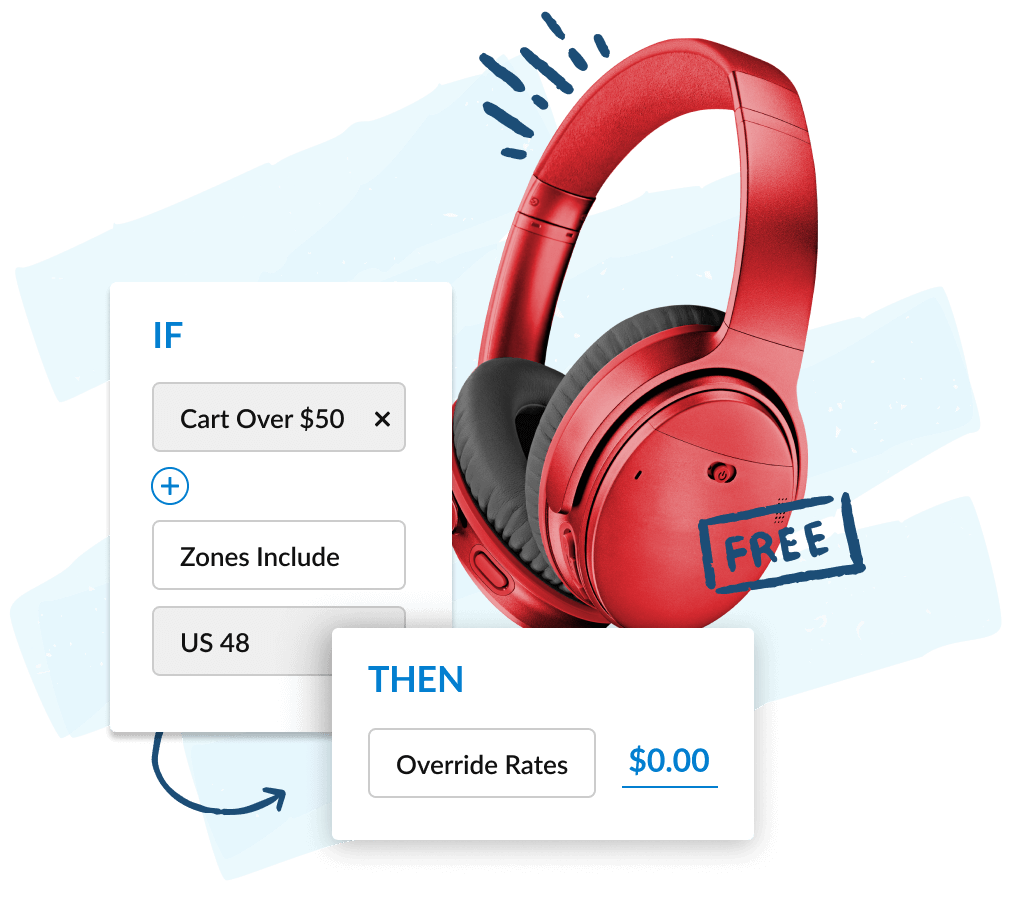
At checkout, these rules determine which methods appear, how rates are calculated, and what delivery timelines are shown. Common inputs include:
- Customer location and shipping zone
- Product size, weight, and category
- Order value and cart composition
- Fulfillment location and inventory availability
- Carrier services, cutoffs, and constraints
With a well-configured shipping setup, ecommerce teams can:
- Show a specific delivery date based on lead times, cutoffs, and holidays
- Offer free shipping above a defined order value and exclude oversized items
- Display parcel options for small products and freight options with accessorials for large or heavy items
- Hide express delivery for pre-orders or items with extended handling times
- Disable certain services for destinations or products that cannot support them
- Route orders from the closest fulfillment location to enable faster delivery
When these rules are applied correctly, customers only see shipping options that are accurate and relevant to their order. This reduces friction at the point of decision, and more shoppers end up completing the purchase.
Evaluating Your Shipping Performance at Checkout
Improving conversion rates at checkout starts with understanding where shipping creates friction.
Use the questions below to evaluate whether your current shipping setup supports conversions or quietly works against them.
Shipping Cost and Delivery Date Clarity
- Are shipping costs accurate and predictable for the shopper?
- Do customers see exact delivery dates instead of vague delivery ranges?
- Are irrelevant shipping methods hidden automatically?
Relevance of Shipping Options by Customer and Order
- Do nearby shoppers see pickup or local delivery options when available?
- Are freight options shown only when an order requires them?
- Is express shipping restricted when inventory availability or handling time cannot support it?
Control Over Shipping Promotions and Costs
- Do free shipping offers apply only when they make financial sense?
- Are oversized and freight items excluded from blanket promotions?
- Do items ship in the correct box sizes to avoid dimensional overcharges?
Transparency in International Shipping
- Do shoppers see duties and taxes included in the total shipping cost?
- Are the shipping options shown valid for successful delivery to the customer’s address?
If you answered “No” to several of these questions, your checkout experience needs to be re-examined. Each gap increases the chances of cart abandonment, even when purchase intent is high.
Evaluating your shipping experience at checkout is not a one-time task. As your catalog grows, fulfillment locations expand, and carrier pricing changes, your shipping strategy must evolve with the business.
Shipping Should Not Be an Afterthought in Conversion Rate Optimization
Optimizing conversions is really about making it easier for customers to say yes at checkout. Inefficient shipping often gets in the way of that.
When shipping costs feel higher than expected, delivery dates are vague, or the options shown do not make sense, shoppers leave without finishing the purchase. On the other hand, when shipping is clear and predictable, checkout feels smooth and trustworthy.

Treating shipping as just a backend task leaves a gap in your conversion strategy. Whereas getting it right helps you:
- Set clear expectations before the customer places the order
- Avoid last-minute surprises like high shipping costs that lead to abandoned carts
- Make the checkout process seamless and reliable
- Increase repeat purchases over time
In 2026, checkout optimization is critical for every ecommerce business. Therefore, shipping needs to be treated as part of the overall buying experience and optimized with the same focus as pricing or promotions.